
There is a specific kind of hum in a classroom that is deeply engaged. It’s not silent, and it’s not chaotic. It is the sound of negotiation, discovery, and the clinking of pebbles against plastic.
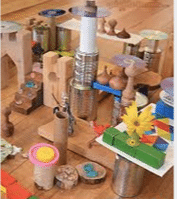
As educators in P3 (Preschool – 3rd Grade), we often feel the pressure to push for “rigor” earlier and earlier. But what if the rigorous thinking we want wasn’t found in a worksheet, but in a basket of pinecones, washers, and fabric scraps?
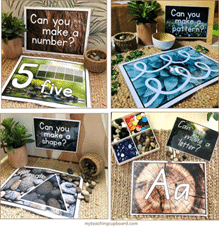
This is the world of Loose Parts—an approach that feels like play to the child, but looks like deep cognitive science to the teacher. Whether you are building patterns and letters in TK or teaching multiplication arrays in 3rd grade, loose parts can bring a sense of warmth and limitless possibility back into your room.
The Why
We know intuitively that children love “junk.” Give a child a shiny new toy, and they play with the box. But why?
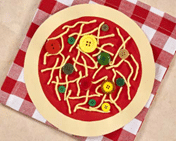
Simon Nicholson, coined “loose parts,” off of his theory of variables, proposing that the “degree of inventiveness” in learning experiences is directly tied to the number of variables in it. A fixed toy (like a plastic pizza) has one outcome or variable. Loose materials have infinite outcomes. Infinite outcomes lead to infinite neural pathways. Further, natural, open-ended materials evoke a sense of calm and aesthetic appreciation that brightly colored plastic cannot. When the environment is beautiful and flexible, children treat their work with more respect and focus. Play with unstructured materials requires more verbal negotiation than play with structured toys. This taps into the imaginary, flexible thinking part of the brain where abstract thought eventually leads to the rewiring in order to learn letters.
The TK & Kindergarten “Laboratory”
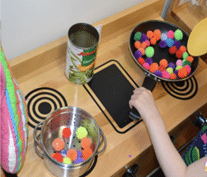
In our youngest grades, we want to see sensory exploration merging with early symbolic thinking. Loose parts bridge the gap between imaginary and real play.
Real Classroom Moment: “The Soup Kitchen”
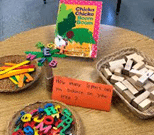
- The Setup: A sensory table or large bin filled not with sand, but with “ingredients”: dried pasta, acorns, snippets of green yarn (herbs), and polished stones, along with real metal ladles and bowls.
- The Play: A group of TK students isn’t just “playing house.” They are sorting the acorns by size (math). They are negotiating who gets the big ladle (social-emotional). They are narrating a recipe (oral literacy).
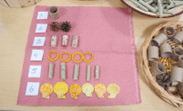
- Invite every child to bring in a collection of loose parts to use in math. Send home a ziploc bag with a child’s name on it, and you’ll receive multiple counting collections back that you can use to support different skill building. Children SHINE when you pull their counting collection to work with!
Real Classroom Moment: Transient Art
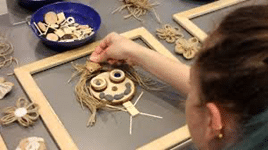
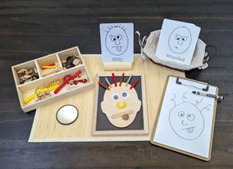
- The Setup: A “invitation to create” on a table with empty picture frames and small loose parts like glass gems, buttons, and shell fragments.
- The Play: Students arrange the items inside the frames to make faces, mandalas, or scenes. Because nothing is glued down, there is no fear of making a “mistake.” They can adjust and redo endlessly.
In Practice: The 1st – 3rd Grade “Studio”
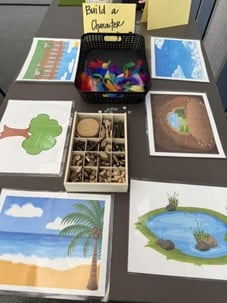
As children move into primary grades, the academic demands rise. We can use loose parts to make those abstract concepts (narrative structure, geometry, physics) concrete and tangible.
The Vibe
Here, the materials are smaller and more complex. The “Play Center” evolves into a “Design Studio” or “Story Workshop.”
Real Classroom Moment: The Story Workshop
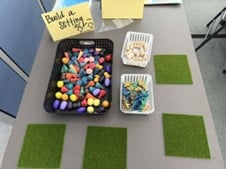
- The Research Connection: Educational researchers have found that physically building a story increases the quality of the writing.
- The Activity: Before writing their “Small Moment” narratives, 2nd graders are invited to build the memory.
- The Example: Leo wants to write about the time he broke his arm. He can’t find the words. He goes to the loose parts wall. He chooses a jagged piece of bark to represent the “pain” and uses white string to wrap around a figure for the “cast.”
- The Result: When he sits down to write, he doesn’t say “It hurt.” He writes, “It felt sharp like jagged wood.” The loose parts unlocked the descriptive language.
Real Classroom Moment: Math Arrays & Geometry
- The Activity: Instead of a worksheet with rows of apples, 3rd graders are given a jar of ceramic tiles or bottle caps.
- The Challenge: “Can you build a rectangle with an area of 24?”
- The Discovery: Students physically manipulate the caps to find that a 4×6 rectangle and a 3×8 rectangle look different but contain the same amount.
Building Collections!
You don’t need a grant to start this. You just need to look at “trash” differently.
- The Parent Letter: Send a note home asking for “Beautiful Junk.” List things like: old keys, corks, unused nuts and bolts, fabric scraps, costume jewelry, wooden clothespins, and sea glass.
- Thrift & Nature Walks: The best loose parts are often free. A bag of pinecones from the park or a handful of smooth stones from the beach are treasures to a child.
- Start with One Basket: Don’t overwhelm yourself. Put one basket of stones in the block center. Just watch. See how the children combine the stones with the blocks. The magic will start there.
When we offer children loose parts, we are giving them a compliment. We are saying, “I don’t need to tell you how to play. I trust your imagination.” We are inviting them to bring their whole selves—their stories, their logic, and their wonder—into the classroom.
And that is a beautiful way to spend a school day.
